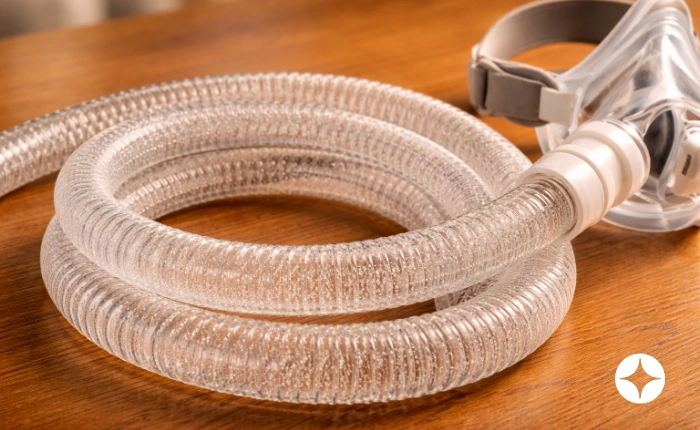
Most CPAP users rarely think about their hose—until something feels off. Maybe your therapy suddenly feels colder, you notice moisture in the tubing, or your mask starts pulling during the night.
If you’ve been using CPAP for a while, these changes aren’t unusual. What many users don’t realize is that your CPAP hose plays a direct role in comfort, airflow stability, and overall therapy experience. Understanding the different hose types—and when to switch—can help you fine-tune your setup and maintain consistent results.
Why Your CPAP Hose Matters More Over Time
Unlike masks or machines, hoses are often overlooked. But over time, they are exposed to:
- Constant airflow and pressure
- Temperature changes
- Moisture from humidification
These factors can affect how air is delivered. Research shows that temperature and humidity inside the CPAP system directly influence comfort and airway hydration, particularly in colder environments.1 When these variables shift—even slightly—users may experience dryness, condensation, or disrupted sleep.
The 3 Main Types of CPAP Hoses
1. Standard CPAP Hose (Non-Heated)
What it is: Basic plastic tubing that delivers pressurized air from your machine to your mask.
Best for:
- Stable room temperatures
- Users who don’t require humidification
Limitations:
- Prone to condensation when used with humidifiers
- Airflow temperature fluctuates with room conditions
- May feel colder during winter months
When warm, humid air travels through a cooler tube, condensation can form—a phenomenon commonly known as “rainout”.2
2. Heated CPAP Hose
What it is: Tubing with an integrated heating element that maintains consistent air temperature as it travels to your mask.
Best for:
- Users experiencing condensation (rainout)
- Dry nose, throat, or mouth
- Seasonal temperature changes
Why it matters for long-term users: Clinical research shows that heated tubing helps maintain stable humidity and prevents condensation by keeping air above the dew point.1 This can reduce dryness and improve overall comfort—especially in colder environments where CPAP side effects tend to increase.
New insight for experienced users: Research also shows that even without active heating, insulating the CPAP tube can significantly reduce heat loss and condensation, improving humidity delivery.3 This means users who don’t have a heated hose can still improve comfort by using a hose cover or insulating wrap—an often overlooked alternative.
3. Slim or Lightweight CPAP Hose
What it is: A narrower, more flexible hose designed to reduce drag and improve movement during sleep.
Best for:
- Active sleepers
- Users bothered by hose weight or pulling
Trade-offs:
- May feel different in airflow delivery
- Not ideal for higher pressure settings in some cases
While not directly impacting humidity, these hoses can significantly improve mobility and perceived comfort, especially for long-term users who change sleep positions frequently.
A Fourth Option to Consider: Hose Insulation (Often Overlooked)
While not a separate hose type, insulation is a powerful upgrade for existing setups. Tube insulation—such as fabric hose covers—helps retain heat as air travels from the machine to the mask.
Clinical findings suggest that insulating CPAP tubing can improve humidity delivery and reduce condensation, even when heated humidification is already in use.3
Best for:
- Users who experience mild to moderate rainout
- Those in cooler climates or seasons
- Users who want improvement without upgrading to a heated hose
Why this matters:
- Insulation offers a lower-cost, low-effort way to stabilize airflow conditions—making it especially valuable for long-term users optimizing an otherwise stable setup.
Signs Your CPAP Hose May Be Affecting Comfort
If your therapy feels different than it used to, your hose may be contributing. Common signs include:
- Condensation or water droplets in the tube
- Cooler or drier air than expected
- Stiffness or reduced flexibility
- Subtle odors or lingering moisture
- Increased mask movement during sleep
Condensation, in particular, is a strong indicator. It occurs when humidified air cools inside the tube, forming water droplets that can disrupt airflow and sleep quality.
Choosing the Right Hose for Your Needs
Rather than thinking of hoses as interchangeable, consider them part of your comfort optimization strategy.
If you experience… → Consider
- Rainout or condensation → Heated hose or insulated cover
- Dryness or irritation → Heated hose + humidifier
- Frequent movement → Slim hose
- Stable environment → Standard hose
For many long-term users, upgrading to a heated hose isn’t about starting therapy—it’s about refining it.
Hose Maintenance and Performance Over Time
Even the right hose type won’t perform well without proper care. Over time, moisture exposure and regular use can affect:
- Flexibility
- Airflow consistency
- Overall comfort
Best practices include:
- Regular cleaning and complete drying
- Avoiding trapped moisture after use
- Replacing hoses every 3–6 months or as recommended
- Ensuring hose covers or insulation are also kept clean and dry to maintain effectiveness
Moisture buildup is not just a comfort issue—it can also influence how air is delivered through the system over time.
Small Change, Big Impact
Many CPAP users focus on masks or machines when something feels off—but the hose is often the missing variable.
A simple change in tubing type can:
- Reduce condensation
- Stabilize airflow temperature
- Improve overall comfort3
For long-term users, this isn’t about fixing therapy—it’s about optimizing it. Your CPAP hose isn’t just a connector—it’s a key part of how your therapy feels night after night. As your environment, equipment, and behaviors change over time, your hose may need to change too.
By understanding the differences between hose types and recognizing when adjustments are needed, you can maintain consistent comfort, reduce disruptions, and get the most out of your CPAP therapy.
References
- PubMed / National Center for Biotechnology Information, Mask humidity during CPAP: influence of ambient temperature, heated humidification and heated tubing
- SoClean, CPAP Rainout: How To Manage Water In The Tube and Keep Your CPAP Clean
- PubMed, Heated humidification during CPAP with and without tube insulation