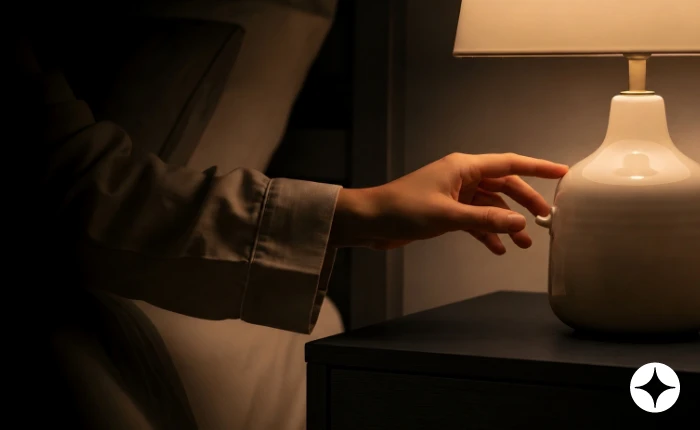
You wake up, glance around the room, and realize you're wide awake.
Maybe it's 2:47 AM. Maybe it's 3:15. Either way, your first thought might be: Why am I awake? Is something wrong with my sleep apnea treatment?
For many adults, especially those over 40, waking up during the night is surprisingly common. As we age, sleep naturally becomes lighter and more fragmented, making nighttime awakenings more likely—even in people who are otherwise healthy and sleeping well.1,2
The good news? A brief awakening doesn't necessarily mean your sleep apnea treatment isn't working or that you've had a bad night's sleep. In fact, what you do after waking may have a bigger impact on the rest of your night than the awakening itself.
Why Nighttime Wakeups Happen
Sleep isn't a single, continuous state. Throughout the night, your body cycles through different stages of sleep, including light sleep, deep sleep, and REM sleep. As we get older, we tend to spend less time in deep sleep and experience more frequent awakenings and arousals. 1,2
For people with sleep apnea, untreated breathing interruptions can certainly contribute to nighttime awakenings. However, even individuals who successfully use CPAP therapy may occasionally wake during the night due to stress, noise, temperature changes, medications, or simply normal age-related changes in sleep. 1,3
That's why a middle-of-the-night awakening isn't automatically a sign that your therapy isn't working.
Four Things to Avoid When You Wake Up
1. Don't Check the Clock
One glance at the clock can quickly turn into mental math:
"If I fall asleep right now, I'll still get four hours..."
This type of sleep-related worry can increase alertness and make it harder to relax. Sleep experts often recommend keeping clocks out of view so you aren't tempted to monitor the night. 4
2. Don't Reach for Your Phone
Checking email, scrolling social media, or reading the news may seem harmless, but it sends your brain the opposite message of what you're trying to achieve.
Electronic devices expose you to light and stimulating content that can increase wakefulness and make it more difficult to drift back to sleep. 4
3. Don't Turn On Bright Lights
Light is one of the strongest signals that regulates your body's sleep-wake cycle.
If you need to get up, use the lowest level of light possible. Bright overhead lighting can signal to your brain that it's time to be awake rather than asleep. 4
4. Don't Assume Something Is Wrong
This may be the most important one for people treating sleep apnea.
A brief awakening does not automatically mean your mask is leaking, your therapy settings are wrong, or your treatment isn't effective. While persistent sleep disruption should be discussed with your healthcare provider, occasional awakenings are normal—even among people without sleep disorders. 1,3
If you notice a genuine comfort issue, such as a mask leak, dryness, or discomfort, address it and settle back into bed. Try not to turn a temporary wakeup into a middle-of-the-night troubleshooting session.
What to Do Instead
Rather than focusing on getting back to sleep immediately, focus on becoming relaxed.
Take slow, comfortable breaths. Perform a gentle body scan, relaxing your jaw, shoulders, chest, and legs. If you notice a genuine comfort issue—such as a mask leak or dryness—address it and settle back into bed.
Most importantly, remember that rest still has value. Quiet relaxation in a dark room is far more restorative than lying awake worrying about the fact that you're awake.
When to Talk to Your Doctor
If nighttime awakenings are frequent, worsening, or accompanied by excessive daytime sleepiness, morning headaches, loud snoring, or difficulty tolerating CPAP therapy, speak with your healthcare provider. Sleep apnea isn't the only condition that can disrupt sleep, and persistent symptoms deserve evaluation. 3,4
The Bottom Line
Waking up during the night is a normal part of sleep for many adults, particularly as we age. The key is not allowing a brief awakening to become an hour-long period of frustration.
By avoiding a few common mistakes—checking the clock, reaching for your phone, turning on bright lights, and assuming something is wrong—you can give your body the best opportunity to relax and return to sleep naturally.
References
- Sleep Science and Practice, Sleep and Aging
- PubMed, Age-related Increase in Awakenings: Impaired Consolidation of NonREM Sleep at All Circadian Phases
- Healthline, What You Need To Know About Middle Insomnia: Symptoms, Treatment, and More
- Mayo Clinic, Insomnia: How Do I Stay Asleep?